About the photograph on the start page
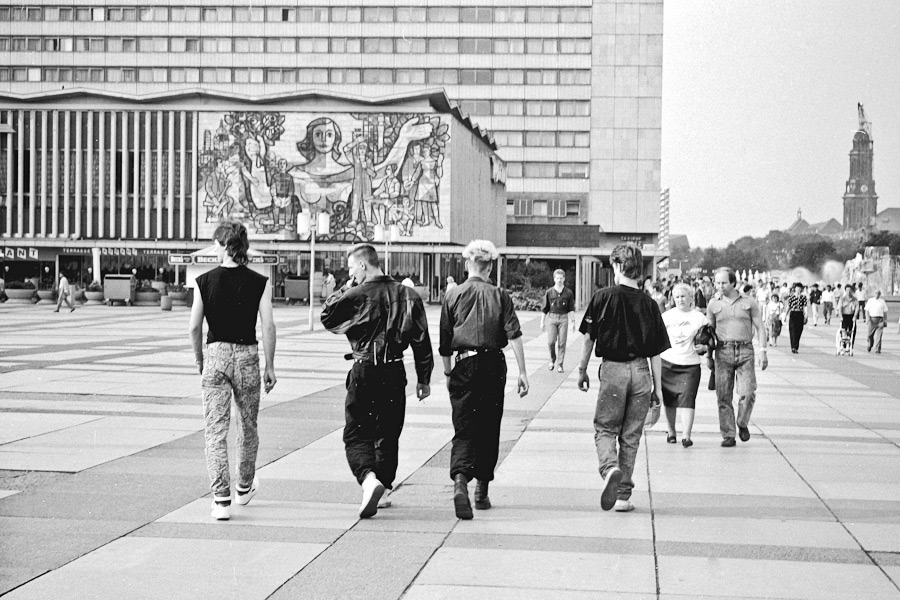
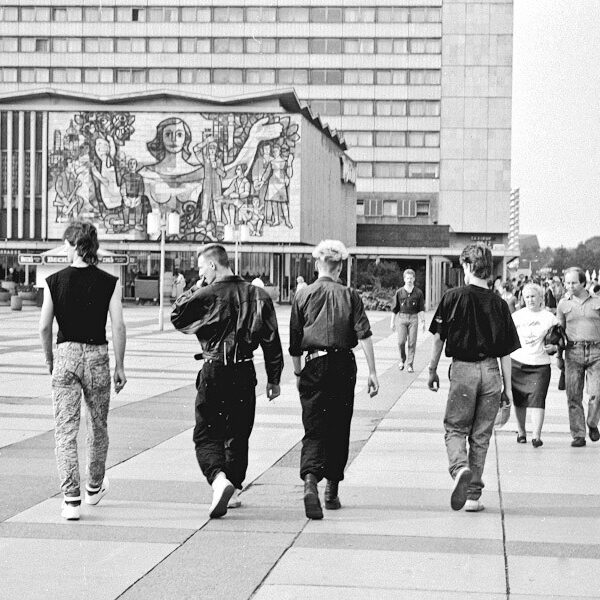
A group of people on their walk towards a restaurant building on a pedestrian shopping street. We see four young men with their backs to us.
They may be approaching the bulding with the large mural, showing a person that is looking at the beholder. In the background there is some more people walking on the promenade, who are directed towards us.
We can not know their ways. Still, the photograph, taken most likely in 1990, is telling us something about a changing city scape after the breakdown of communist rule. It evokes the questions the [L]Ost Places project is concerned with: How were socialist city scapes planned out and intended to be used? How were they actually used? What changed during times of rupture and transformation? What happens there today?
In addition, the mural is a fitting invitation. We do not necessarily have to identify with its intended meaning, rooted in Socialist Realism, but the gesture remains: Welcome to the city and welcome to a shared endeavour in discovering places of the past and their present and future meanings.
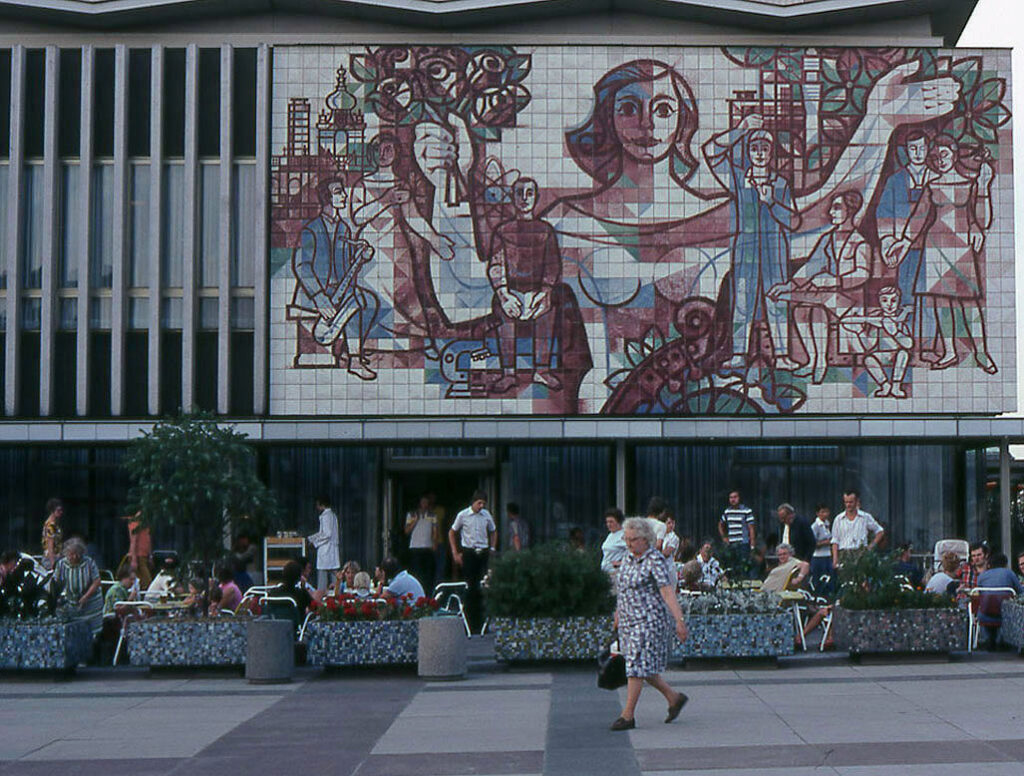
Dresden grüßt seine Gäste (1968/69) by Kurt Sillack and Rudolf Lipowski
Picture: Dresden, Restaurant Bastei, Prager Straße, Manfred Kühn (1976), CC BY-SA 4.0,
https://commons.wikimedia.org/wiki/File:Dresden_Restaurant_Bastei_1976.jpg
As part of a much greater conception of a far stretched modernist ensemble of housing, shopping, tourism and – not to the last – showcasing socialist success, the art work on painted tiles had a clear message to provide:
the mural Dresden grüßt seine Gäste (Dresden is Greeting its Guests) faces the central station and is installed at the southern façade of the restaurant Bastei at the end of the axis [connecting the train station and the central Altmarkt square]. It shows a great female figure with a bunch of roses in her raised hand surrounded by members of different professions, a child and emblems of Dresden. The figure as well as the emblems symbolise the city of Dresden while the different figures around it express the ideal of the socialistic society. Combined the mural marks the rebuilding of Dresden as a socialist city. (Fülscher 2013)
The photograph, taken by Ralf Menzel, holds yet another story. The art is still there but conditions and circumstances have changed or are about to do so.
In front of the restaurant is a beer stand, equipped with the logo of the West German Becks brewery. But not only the possibilities of consumption had changed. Most probalby the people in the picture were on their ways to paths in life, they had not foreseen before the rupture in history.
The place would change a lot over the years as well.
Nowadays the allegoric welcome note is hidden behind more recently build infrastructures of the city.
Can you find it?